Thank you for Subscribing to Environmental Business Review Weekly Brief

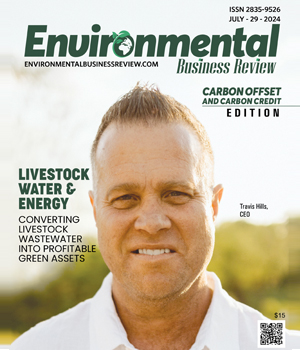
 Travis Hills, CEO
Livestock Water & Energy (LWE) is turning the tide on longstanding, environmentally costly methods of livestock manure management. In the heart of America’s dairy and hog farms, vast, open pits—called manure lagoons— have been the go-to solution for handling overwhelming volumes of manure. These farm ponds mix manure with water, store it, and eventually apply it to fields. Simple as it sounds, this method carries a hidden, hefty environmental price tag.
 As these open pits stagnate, they emit noxious odors that deteriorate air quality and produce methane, a greenhouse gas that drastically amplifies a farm’s carbon footprint.
LWE’s breakthrough is its high flux vacuum membrane distillation (HFVMD) technology, a game-changer in sustainable manure management.
The technology exploits vapor pressure differences to separate manure solids from the liquid mixture. This treatment curbs harmful methane emissions and odor generation at the source in real time, as the manure is not left to decompose in open-air storage facilities.
This transformative process preserves all the vital nutrients of the manure, recycling them into valuable resources—clean, reusable potable water, high-value dry fertilizers and potash—each playing a crucial role in farming operations. Adopting such a sustainable cycle also empowers farmers to generate carbon credits, a financial incentive to adopt environmentally friendly practices.
This equates to “having a closed-loop farming system where no livestock waste is discarded,” says Travis Hills, CEO. “We are not just cleaning up their farms. We are transforming livestock barns into eco-friendly community assets by reducing off-gassing to zero.”
Recycling Wastewater for Farming Benefits
In a critical era of water conservation, LWE’s solution is a game-changer. Often overlooked, manure sludge wastewater contains significant volumes of usable water—up to half of what’s involved in manure processing.
HFVMD extracts liquid from livestock manure and applies low heat to produce water vapor. The vapor is exposed to a non-hydrophobic membrane, which acts as a barrier, allowing only pure, vaporized water to pass through while trapping impurities. Enhanced by a vacuum on the distillate side, the process boosts water vapor flow for higher efficiency. The vapor is cooled and condensed into distilled water, free from contaminants, providing clean water for livestock operations.
The effectiveness of this process is evident in the 80 to 95 percent of water it restores. The high volume of recycled water is a valuable resource that can be used for various purposes such as irrigation, animal cooling, facility washdown, pit flushing and even drinking. Farmers can substantially reduce their reliance on freshwater sources, easing the strain on local water bodies.
LWE’s technology serves as a vital safeguard for waterways, helping farmers reduce the pollution risks from applying wastewater to adjacent fields.
We are not just cleaning up their farms. We are transforming livestock barns into eco-friendly community assets by reducing off-gassing to zero
Once water is separated from manure through distillation, the remaining solid matter is transformed into a valuable organic amendment—pelletized fertilizer.
This nutrient-rich fertilizer, which retains essential elements like nitrogen, phosphorus and potassium from the manure, offers farmers a cost-effective way to increase crop yield and improve soil health. By preserving these vital nutrients, LWE ensures farmers maximize the benefits of manure while minimizing its environmental impact.
 Salt extracted from manure is also processed into potash, a rich mineral that can enhance soil fertility. This innovative approach to manure management allows farmers to get more bang for their buck since recycled manure is a far more valuable fertilizer than its initial waste form.
Creating such diversity from waste takes the financial strain off the farmers’ shoulders, who can substitute farm-produced compost for purchasing chemical fertilizers.
The potential positive impacts extend to improving surrounding air quality. Avoiding anaerobic digestion, LWE eliminates the noxious odors and the spread of airborne contaminants from manure lagoons. It also eliminates the potential for harmful leaks or seepage, ensuring that the farming environment remains pristine and free from pollutants.
This creates a healthier environment for animals and enables farmers to improve productivity, and the overall welfare of the farm and the surrounding community.
Harvesting Green Rewards
HFVMD’s sustainable approach enables farmers to earn valuable carbon credits. The credits can then be sold to companies or individuals seeking to offset their emissions, providing farmers with a tangible financial incentive as a token for establishing environmental stewardship. Now that’s the green revolution!
The impact is visible in the numbers. In Western Minnesota, a hog farmer capitalized on their manure by selling it each fall, earning almost $110,000 annually. Recognizing an opportunity to enhance the farm’s income while supporting sustainable practices, LWE stepped in to transform the client’s livestock operations, redefining the revenue contribution of waste. Using its proprietary technology, LWE converted the hog manure into high-quality dry fertilizer and potash while reducing the farmer’s carbon footprint. These sustainable practices enabled the Minnesota farmer to tap into the growing demand for carbon credits. Major corporations, eager to mitigate their environmental impact, were willing to pay a premium for these credits and were able to use these credits to create a new revenue stream. The farms’ earnings from waste tripled, soaring from $110,000 to $460,000 annually.
In a strategic move to further support farmers, LWE has also partnered with local CO-Ops, adding a layer of stability and financial security for farmers. The family-owned waste collection and recycling firm is an off-taker, purchasing farm-produced byproducts such as dry fertilizers, potash and carbon credits. This collaboration creates a stable market for farmers’ eco-friendly products while strengthening their financial resilience with a new and reliable income stream.
Many smaller farmers find the carbon credit industry and the environmental, social and governance (ESG) marketplace daunting. They recognize the importance and mandate of engaging in these areas—in fact, they’re eager to do so—but they lack the knowledge and resources. LWE guides them through every step of the process. Rather than diving into sustainability for the sake of it, LWE helps farms understand their carbon footprint and create plans targeted to their needs and overarching objectives. The approach is not simply about offering advice but actively demonstrating what actions to take and how to execute them. This enables the farmers to learn and apply cost-effective, carbon-offset practices that contribute to sustainable and economically viable farming.
-
We are looking to totally transform the Ag industry, specifically the hog and dairy sectors. We are creating new revenue streams for farmers, making manure lagoons obsolete, and making family farms sustainable and environmentally friendly
Charting the Course for a Sustainable Future
Embarking on a rapid growth strategy, LWE is projecting to expand its operations from 45 to 65 farms nationwide within the next 18 months. This expansion is indicative of a broader revolution it is spearheading in the agricultural industry toward environmental sustainability. The focus is also on delving into technological innovations and demonstrating to farmers the more efficient methods available—better ways of processing fertilizer, extracting salt as a fertilizer additive and promoting sustainability.
Technologies and processes are crucial, but the employees, at every level, truly drive excellence. LWE’s distinct team of entrepreneurs, biochemists, environmental scientists and engineers brings a rich blend of expertise to manure management. This collaborative synergy allows the company to craft innovative solutions tailored to the complex challenges of modern agriculture, where sustainability and profitability can go hand in hand.
With LWE, every farmer’s barn is elevated to ensure no wastewater or manure goes into the pit. Instead, it is recycled to improve productivity and the overall welfare of the farm. As the company puts it, ‘Don’t waste perfectly good waste.’
