
Thank you for Subscribing to Environmental Business Review Weekly Brief

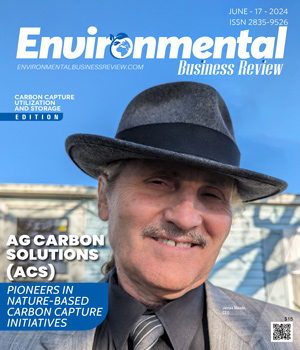
 James Meade, CEO
 Amid rising global climate challenges, the Intergovernmental Panel on Climate Change (IPCC) has highlighted the necessity of capturing previously emitted carbon to maintain safe atmospheric carbon levels and counteract climate change, alongside forthcoming substantial reductions in human-caused emissions. Current research predominantly targets carbon capture and storage (CCS) and reforestation, while the potential of soil as a carbon sink on agricultural lands remains underexplored.
 Ag Carbon Solutions (ACS) steps in with the Agricultural Production System (APS), a patented organic approach to harnessing soil as the linchpin in removing carbon dioxide from the atmosphere. The company’s innovative methodology uses clean, carbonaceous resources diverted from waste streams, which are turned into soil amendments through a process called the “Dry Decay Method” The resulting byproducts (i.e., silvicultural residuals) are then buried below the water table to capture carbon.
This nature-based solution not only revitalizes ecosystems and economies but also creates new pasturelands, enhances soil fertility, and provides effective responses to various solid waste issues.
James Meade, CEO, emphasizes, “We play a crucial role in landfill conservation, establishing Permanent Agricultural Land (PAL), and ushering in substantial new revenue streams for farmers through sustainable industrial practices.”
Adding to the appeal, the company’s agricultural strategy is unrivaled in cost-efficiency, effectiveness, sustainability, and scalability, representing a significant advancement in carbon capture for climate change mitigation. It epitomizes the synergy between ecological responsibility and economic vitality, setting a benchmark for future endeavors in the agricultural sector.
 ACS is transforming agricultural waste into valuable resources, promoting a circular economy that enhances soil fertility, reduces landfill use, and supports the agricultural sector’s sustainability. Their commitment to innovation and sustainability makes ACS a leader in the agricultural and environmental business sectors, poised for significant impact on both local economies and the global environment.
Contributing to More than Carbon Reduction
The atmosphere and oceans are currently saturated with excessive carbon, while soils have experienced significant carbon depletion due to urban development, the transformation of native forests into croplands, and agricultural practices that reduce soil organic matter.
ACS introduces a revolutionary approach to combating climate change with its APS. This method initiates with a “soil exchange” on agricultural lands, where inorganic sands are replaced with clean wood and vegetative materials. Selected wood waste (such as dead trees, stumps, and tree trimmings) is collected and temporarily stored in above-ground stockpiles.
These materials are then densely compacted below the water table using pumps and heavy machinery and capped with a layer of topsoil to create anaerobic conditions that prevent the decomposition of the stored silvicultural materials. The result is massive carbon sequestration, with the added benefit of agricultural land being returned to its original grade with improved function as grazing land or cropland, all while creating PAL.
There’s no methodology that can sequester carbon in a more cost-effective way and more quickly. Moreover, it can be replicated all over the world by taking carbon that’s already sequestered in plant material and lignin and putting it into the ground below the water table for tens of thousands, maybe millions of years
The company’s comprehensive strategy not only illustrates their innovative approach to carbon sequestration but also highlights their broader impact on enhancing agricultural productivity and sustainability. This refined narrative ensures that ACS’s contributions are vividly portrayed, offering a compelling case for their recognition as leaders in ecological innovation and sustainable agricultural practices.
Creating Positive Impacts Overall
Carbon depletion in farmland soils is alarmingly severe, with billions of tons of carbon either released into the atmosphere or lost through erosion. As a result, many descendants of farming families find themselves unable to sustain agricultural operations, largely due to the financial pressures that demand high returns. Consequently, when developers present tempting offers—such as $40,000 per acre for their land—these heirs frequently choose to sell. This trend not only converts valuable farmland into urban developments but also endangers the agricultural heritage and threatens the sustainability of farming communities across the nation.
Farmers have the potential to double or even triple their income per acre by leasing to ACS.
The company works with farmers, particularly those in the cattle industry, due to the practical benefits of converting land into grazing areas. Upon agreement, ACS enters into a lease with the farmer, offering compensation for the materials removed and added to their property. The procedure includes excavating the land, transferring sand and inorganic materials to construction businesses, and stockpiling wood waste for compaction beneath the water table.
This method effectively captures significant amounts of carbon. ACS’ pilot facilities in Orlando demonstrate the capability to sequester over 100 tons of carbon daily, which is equivalent to offsetting 367 tons of CO2 emissions. In practical terms, this is comparable to the environmental benefit of planting 3 million trees annually, making a substantial contribution to carbon capture efforts. Farmers can also benefit financially by receiving a portion of the carbon offset credits generated, enhancing the economic appeal of participating in this endeavor.
A standout example is a ranch in Orlando, Florida. Facing foreclosure due to financial challenges from maintaining their large farm, the family sought a sustainable solution to continue their agricultural operations. ACS provided a contract that offered enough cash flow to avert foreclosure and maintain the farm’s operations. This intervention has not only secured the ranch’s financial stability but also preserved its agricultural heritage, ensuring its economic sustainability in the face of adversity.
The Collaboration Transforming Landscapes
ACS operates with a multidisciplinary team of key collaborators who are pivotal in advancing the company’s mission. At the forefront of this collaboration is HSA Golden, a respected environmental engineering firm headed by Jack Smith. His expertise has been crucial in navigating challenges and gaining recognition and approvals from state and local governments for ACS’ innovative practices.
-
We play a crucial role in landfill conservation, establishing PAL, and ushering in substantial new revenue streams for farmers through sustainable industrial agriculture practices
Dr. Ning Zeng, a scientist from the University of Maryland, has lent his expertise and credibility to the team. His seminal white paper on the methodologies of ACS spurred the patenting process and stands as a foundational document for proving the effectiveness of their approach.
Furthermore, the company maintains strategic partnerships with various entities, including Ivetic, a company that supports revenue generation through soil transportation. Under the leadership of Meade, these alliances and expert collaborations have the opportunity to foster the pursuit of sustainable, profitable agricultural practices and effective carbon sequestration.
Offsetting Carbon with Principal, One Acre at a Time
ACS sources its golden ingredient, “clean debris”, from yard waste that would otherwise contribute to landfill congestion. Recent studies indicate that yard waste makes up to 30 percent of municipal solid waste in the United States, underscoring the importance of the APS in waste management strategies. By repurposing this vegetative waste for agricultural use, the company not only enhances soil fertility but also alleviates landfill strain.
Another component of the strategy involves small waste-to-energy facilities, which use some of this material as fuel. Although this use is minimal, focusing primarily on carbon offsets, it represents a shift towards utilizing materials that are essentially carbon neutral compared to traditional fossil fuels. The carbon in these materials was part of the biosphere relatively recently, unlike carbon from oil or gas, which was sequestered millions of years ago. This further exemplifies their holistic approach to environmental stewardship as well as their concerted efforts to contribute to a carbon-neutral cycle that emphasizes the reuse and recycling of biogenic materials.
While waste-to-energy conversion is a future phase, ACS’ current focus is on advancing carbon offsets within the agricultural sector. This includes challenging prevailing misconceptions about the environmental impact of cattle ranching. The project aims to make cattle ranching carbon negative, revolutionizing the industry striving for carbon negativity.
By implementing APS, ACS plans to sequester more carbon than the industry emits, thereby offsetting its environmental footprint. This initiative goes beyond simple emission reduction; it aims to transform cattle ranching through sustainability and environmental stewardship. Meade emphasizes that the benefits of this endeavor extend beyond cattle farming, potentially improving various agricultural practices and promoting a more sustainable approach to food production.
This comprehensive strategy highlights ACS’ dedication to environmental stewardship and sustainable land management, providing a model for promoting carbon-negative agriculture across diverse sectors.
Market Expansion and Strategic Goals
ACS is positioned within a rapidly growing market, fueled by increasing environmental awareness and a global shift towards sustainability. The patented methodologies ACS employs address critical needs in carbon footprint reduction, waste management, and renewable energy—areas of significant interest to eco-conscious corporations and consumers alike.
The business strategy includes expanding operational capabilities and technological infrastructure, which will enable ACS to scale up its innovative environmental solutions effectively. Investment in equipment like fast electric vehicle (EV) chargers and advanced solar power systems is planned to meet the increasing demand for clean energy and sustainable agricultural practices.
Financial projections suggest robust growth driven by diversified revenue streams, including carbon credits, renewable energy production, and consulting services. These financial forecasts reinforce the company’s strategic objectives of enhancing operational efficiencies and expanding into new markets, positioning ACS at the forefront of environmental innovation.
ACS is on a transformative journey to revolutionize the agricultural and environmental sectors. With a solid operational foundation and strategic expansion plans, the company is well-prepared to deliver significant environmental and economic benefits on a global scale.
